
For decades, older adults and families evaluating long-term care options have often faced a difficult reality: While many communities provide compassionate and clinically sound care, the traditional nursing home model has often felt “institutional” … more like a hospital than a home.
Today, however, the senior living and care industry is in the midst of a meaningful paradigm shift. Among the most compelling and research-supported innovations is the Green House® Project, a model that challenges conventional assumptions about what senior living, and long-term care in particular, can look like.
For older adults considering their future, and for industry professionals working to shape it, the Green House model represents more than a shift in campus design. It reflects a fundamental metamorphosis in the setting and quality of long-term care delivery, as well as a redefining of concepts like autonomy, staffing, and community.
What is the Green House Project?
Founded in 2003 by Bill Thomas, MD, the Green House Project is a nonprofit initiative dedicated to transforming senior living and long-term care by replacing large, institutional facilities with small, home-like residences.
Now operating in partnership with Pioneer Network under the umbrella organization AgingIN, the model developed by the Green House Project has expanded across dozens of states (plus Canada and Australia) and continues to influence how forward-thinking providers strategically plan transformative changes to the senior living and care model.
>> Related: Find a Green House community near you
Characteristics of the Green House model
At its core, the Green House model is built around three foundational pillars:
Real home
A “real home” is not simply about aesthetics; it reflects scale, privacy, and comfort for its residents. Ongoing research consistently shows how small-house assisted living models improve residents’ perception of dignity and autonomy compared to more traditional long-term care facilities.
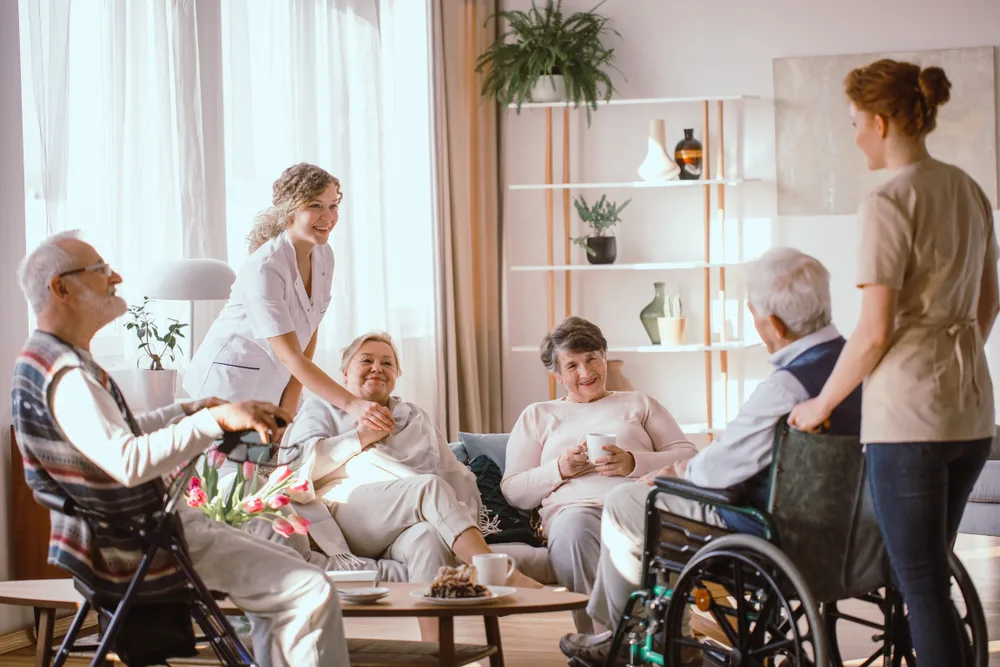
With this in mind, a Green House home typically accommodates 10 to 12 residents (intentionally referred to as “elders” under the model), each with a private bedroom and bathroom. The house includes an open kitchen, a shared living area, and spaces that look and feel like a home rather than a medical unit. Meals are often prepared within the home with residents gathering around a dining table to share the meal together.
Meaningful life
The concept of a “meaningful life” centers around resident choice and engagement. Elders in a Green House are not passive recipients of care but rather active participants in daily life. The day’s activities unfold organically for each resident, not according to a set, institutional schedule.
We know that independence is important for all older adults. This model of senior living and care not only enables autonomy, but facilitates it. This is likely one of several reasons studies have found higher satisfaction scores and improvements in both quality-of-life and quality-of-care measures among Green House residents relative to their traditional nursing home counterparts.
Empowered staff
An “empowered staff” is perhaps the most transformative element of the Green House model as compared to other senior living and care models. Staff operate within a flattened organizational structure, supported by clinical professionals but given authority to make day-to-day decisions that support residents’ needs and preferences.
It is likely no coincidence that research shows Green House communities often experience lower staff turnover. What’s more, studies also reveal that staff members typically spend more direct care time per resident than in a traditional long-term care setting, sometimes adding 20 to 30 additional minutes of direct caregiver engagement per day. In an industry facing ongoing workforce challenges, this model reframes caregiving as meaningful, relationship-based work rather than mere task completion.
>> Related: Prioritizing a Culture of Respect and Compassion in Senior Living
A distinctive care delivery model within Green House communities
These three defining pillars are central to the Green House model, but another important differentiator between these communities and more traditional assisted living or nursing homes is how care is delivered to residents.
Consider a “traditional” long-term care setting: Care is often structured around departments, task assignments, and efficiency metrics. Staff roles are segmented. Schedules are centralized. Residents may have limited autonomy with little say in when they wake up, eat, bathe, or engage in activities.
In a Green House home, residents’ care and daily lives are structured quite differently. Caregivers within the Green House are called Shahbazim, a word derived from an ancient Persian word meaning “king’s falcon.” Shahbazim are typically certified nurse aides (CNAs) trained as universal workers, providing “elders” (the home’s residents) with personal care, preparing meals, and supporting household routines.
This consistent, empowered team structure fosters deeper relationships between caregivers and residents. Rather than rotating staff interacting briefly with residents across shifts (as is common in many long-term care settings), the Green House model emphasizes continuity and familiarity.
The result is a rhythm of life that mirrors a family home more than institutional living. Residents choose when to wake up in the morning; meals are shared around a communal table; conversations and activities happen naturally throughout the day. The environment encourages participation and contribution, reinforcing individual identity and purpose. And importantly, care quality has been shown to be the same or better within Green House communities as compared to a traditional long-term care setting.
>> Related: Attending to Assisted Living Residents’ Medical and Mental Health Care Needs
Benefits compared to traditional long-term care
For families, the Green House model for senior living and care often translates into a palpable difference when they walk through the door. Instead of a long, sterile corridor with nursing stations, they encounter an inviting living room, the smell of food cooking, and a true sense of belonging. And a growing body of research supports what many families intuitively sense when they visit their loved one in a Green House: This nurturing, intimate environment changes outcomes.
Studies have demonstrated reductions in hospital readmissions and certain adverse clinical events for Green House residents when compared to the average nursing home unit. During the COVID-19 pandemic, small-home models, including Green House homes, often experienced lower infection and mortality rates than larger institutional facilities, reinforcing the impact of scale and staffing consistency.
Equally important are the intangible benefits of the Green House model. Residents frequently report greater feelings of dignity and control. Families describe more transparent communication and stronger relationships with staff. Shahbazim caregivers often express higher job satisfaction as their roles feel more holistic and personally meaningful.
For older adults and families evaluating senior living and care options, these differences matter. Where and how you live affects not just your health but your quality of life and sense of self.
>> Related: Improving the Image of Nursing Care & Assisted Living
The Green House model and continuing care retirement communities
Increasingly, we are seeing continuing care retirement communities (CCRCs, or life plan communities) incorporate Green House concepts into their assisted living, memory care, and/or skilled nursing programs, allowing residents to transition from independent living into a small-home environment when higher levels of care are needed.
For example, Jewish Home, a CCRC in Rochester, New York, has developed Green House cottages that provide skilled nursing services within a home-like setting while remaining connected to the campus’s broader continuum of care. Similarly, Taylor Glen, a CCRC in Concord, North Carolina, has incorporated Green House principles into its memory care and other long-term care services.
Such integration offers an appealing pathway for CCRC residents. Instead of moving from an independent living apartment into an institutional long-term care wing, they transition into another “home” on the same campus, preserving familiarity and dignity.
For CCRCs seeking to differentiate themselves in a competitive marketplace, the Green House approach can enhance both mission alignment and consumer appeal. And for older adults considering their future options, it is important that they ask senior living providers for specifics on how they implement the Green House model’s concepts in tangible ways.
>> Related: What is a “Continuum of Care” in Senior Living?
Redefining ‘person-centered care’
The senior living industry has increasingly embraced language around “person-centered care” and “culture shifts.” Yet too often, these concepts remain aspirational — printed in marketing materials without real-world, quantifiable transformation.
The Green House Project operationalizes person-directed care in concrete ways: reimagining staffing models, decentralizing authority, and redesigning physical space. It shifts the primary focus from institutional efficiency to relational depth.
But the broader senior living industry must understand that this is not simply about better programming or more flexible dining hours. It is about acknowledging that aging does not diminish personhood. The Green House model affirms that older adults should maintain agency over their daily routines, relationships, and choices, even when receiving assisted living, memory care, or skilled nursing services.
As our population ages and consumer expectations rise, the senior living and care industry must move from incremental adjustments to bold structural reimagining. The Green House model demonstrates that this is not only philosophically sound, but financially and operationally viable.
>> Related: Better Approaches to Memory Care Assisted Living
Rethinking the future of senior living
The Green House Project challenges all of us within the senior living and care industry to reconsider our assumptions. If small-scale, relationship-centered, home-based models produce better outcomes and greater resident and employee satisfaction, why would we not accelerate their adoption? If empowered caregiving teams foster higher quality care, improve patient outcomes, and increase workforce retention, why would we cling to hierarchical staffing silos?
The fact is that workforce shortages (supply) and demographic pressures (demand) require innovation within the current senior living and care paradigm. At the same time, policymakers and investors are scrutinizing outcomes and value, while consumers demand transparency and humanity. In this context, the Green House model represents more than an alternative to the industry’s status quo; it offers a blueprint for the years to come.
The future of aging will be shaped not only by medical advances, but by the welcoming, comfortable environments we create and the relationships we nurture. The Green House Project reminds us that dignity, autonomy, and meaningful connection are not luxuries in later life; they are essentials. Are we within the industry willing to reimagine long-term care not as a facility to be managed but as a home to be lived in?